Flat roofs cover an enormous proportion of Cheltenham’s built environment — not just the rear extensions and garage roofs of post-war estates, but the parapeted flat sections of Regency townhouses in Montpellier and Pittville, and the canopied entranceways of Victorian terraces across St Paul’s and Fairview.
Flat roofs cover an enormous proportion of Cheltenham’s built environment — not just the rear extensions and garage roofs of post-war estates, but the parapeted flat sections of Regency townhouses in Montpellier and Pittville, and the canopied entranceways of Victorian terraces across St Paul’s and Fairview. If your flat roof needs replacing, you’ll likely be choosing between two systems: GRP fibreglass or EPDM rubber.
What Is GRP (Fibreglass) Flat Roofing?
GRP stands for glass-reinforced plastic. The system is applied in liquid form — layers of fibreglass matting are saturated with resin and rolled out, then a coloured topcoat is applied over the cured laminate. The result is a seamless, rigid, waterproof membrane bonded directly to the roof deck.
GRP became the dominant flat roofing system in the UK through the 2000s and 2010s because of its durability and clean finish. Properly installed, a GRP roof should last 25–40 years without significant maintenance. It’s hard underfoot, which makes it suitable for accessible flat roofs (roof terraces, walkways).
NFRC guidance recommends homeowners obtain a written, itemised quotation and verify a contractor's trade body membership and public liability insurance before agreeing any roofing work.
What Is EPDM Rubber Roofing?
EPDM (ethylene propylene diene monomer) is a synthetic rubber membrane supplied in large rolls and bonded to the roof deck with adhesive. It’s flexible rather than rigid, highly UV-resistant, and has an excellent cold-weather performance — it remains pliable at temperatures down to -40°C. A quality EPDM installation lasts 30–50 years.
EPDM has gained ground rapidly in recent years as material quality has improved and installation techniques have become more standardised. It’s particularly popular for large, simple flat roof areas.
Head-to-Head Comparison
| Factor | GRP Fibreglass | EPDM Rubber |
|---|---|---|
| Typical lifespan | 25–40 years | 30–50 years |
| Cost (per m²) | £70–£100 | £55–£85 |
| Finish | Smooth, hard, paintable | Matte black or grey |
| Suitable for foot traffic? | Yes (with anti-slip) | Light foot traffic only |
| Joins / seams | Seamless | Seamed (excellent if bonded well) |
| Cold weather performance | Good | Excellent |
| Repair complexity | Moderate (specialist needed) | Simple (patch kits available) |
We install both GRP and EPDM flat roofing across Cheltenham. Free survey to advise which system suits your property, with a full written quote.
📞 Call 0124 235 2251 — Free SurveyWhich Is Right for Cheltenham Properties?
For period properties and conservation areas
On Cheltenham’s Regency townhouses — particularly the parapeted flat roof sections visible from the street on Montpellier Terrace or Bayshill Road — GRP’s clean, paintable finish is often preferred. Planning officers in conservation areas occasionally specify that flat roof surfaces should be finished in a colour complementary to the building. GRP accommodates this; standard black EPDM does not.
For rear extensions and garages
For inaccessible single-storey extension flat roofs — the most common job type across Cheltenham’s post-war housing stock — either system performs well. EPDM’s lower cost and long lifespan make it an increasingly popular choice. On larger areas, the flexible membrane also accommodates minor structural movement without cracking, which is useful on older extension structures.
For roof terraces
GRP is the clear choice where the flat roof will be used as an accessible terrace. Its hardness underfoot, compatibility with decking fixings, and seamless surface make it the correct system for this application.
Approximate Costs in Cheltenham
| Job Type | GRP | EPDM |
|---|---|---|
| Single garage (25m²) | £1,800–£2,500 | £1,400–£2,100 |
| Single-storey extension (20–30m²) | £1,600–£2,800 | £1,200–£2,200 |
| Large flat roof (50m²+) | £3,500–£5,500 | £2,800–£4,500 |
Specifying Drainage Correctly on Cheltenham Flat Roofs
The drainage specification is as important as the waterproofing system choice on a Cheltenham flat roof. We specify a minimum 1:60 drainage fall on all new installations — above the statutory minimum of 1:80 — because Cheltenham's above-average rainfall and the sustained autumn and winter wet periods create higher loading than the statutory minimum was designed for. Where the existing deck has less than 1:60 fall, we install tapered insulation boards under the new covering to correct the fall without structural work. This is standard in our Cheltenham flat roof quotes, not an optional extra.
Outlet positioning is the other critical drainage element. An outlet positioned at the lowest point of the deck (correct) drains continuously. An outlet at a central or high point (incorrect, but seen more often than it should be in Cheltenham) means the entire roof ponds to the level of the outlet rim before drainage begins. We survey outlet position on every Cheltenham flat roof assessment and include repositioning in the quote where needed.
Flat Roof Ventilation in Cheltenham
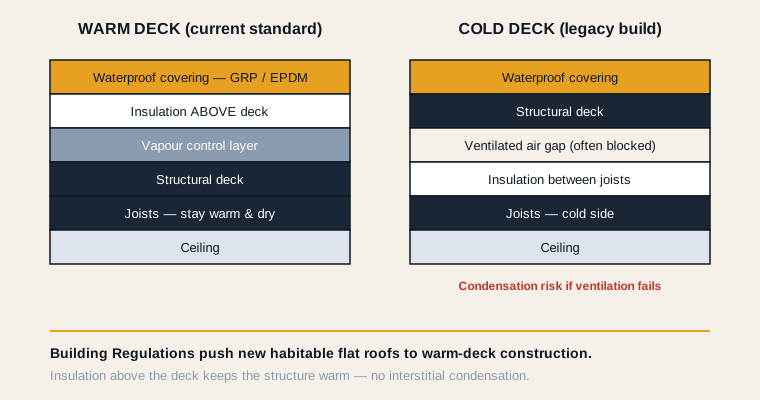
Cold roof flat roof construction — where insulation is placed between the joists below the deck — requires a ventilated air space above the insulation and below the deck to prevent condensation. In Cheltenham's humid climate, inadequately ventilated cold roof decks develop condensation on the underside of the deck board, which causes deck delamination within 5–10 years. Warm roof construction, where insulation is above the deck, eliminates this risk entirely. We specify warm roof construction as standard on all Cheltenham flat roof replacements for this reason.
Last reviewed: August 2026 by Cheltenham Roofing Experts.