It's the question every homeowner with a leaking roof asks — and the honest answer isn't always the one that earns a roofer the most. This guide gives you a clear framework for deciding, based on your roof's age, condition and Cheltenham's specific housing stock.
Tell us the job in 30 seconds. No pushy sales, no call-out fee.
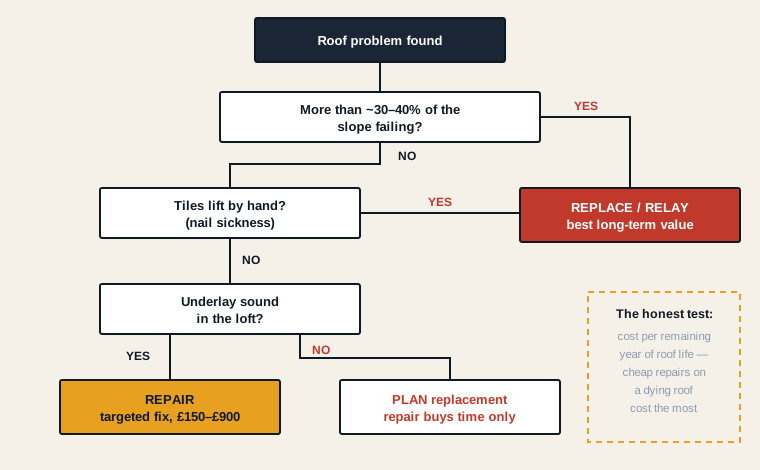
📞 Call Now: 0124 235 2251As a rule of thumb, repair if under about 30% of the covering has failed and the fixings and underlay are sound; replace if more than a third is gone, if tiles lift by hand (nail sickness), or if the underlay has perished. On Cheltenham's post-war estates nail sickness usually tips it toward replacement; on period slate roofs the slate often outlives its fixings and can be relaid.
Four questions settle most cases. We'll give you an honest answer on all four at a free survey — including when replacement would be oversell.
The 30% rule of thumb: if under roughly a third of the covering is damaged and the rest is sound, targeted repair is usually the better value. More than that, and repairing tile-by-tile becomes money poured into a failing roof.
Get a Quote →Nail sickness — corroded fixings letting tiles slip — is the decider on Cheltenham's post-war concrete-tile estates. If a whole slope lifts freely, patching is a losing battle and re-roofing is the honest recommendation.
Get a Quote →Welsh slate on a Regency or Victorian roof often outlives its iron nails by decades. Here the slate itself is usually reusable — a strip-and-relay refixes your original slate rather than replacing it, which changes the maths entirely.
Get a Quote →Even with a good covering, perished felt underlay beneath means water gets past. Sound underlay favours repair; failed underlay across the roof usually means the covering has to come off anyway — so replacement wins.
Get a Quote →The honest test isn't the headline price — it's cost per remaining year of roof life. A £400 repair on a roof with two years left is dearer than a £7,000 re-roof lasting fifty. We do this maths with you honestly.
Get a Quote →If your roof has plenty of life and a contained fault, a re-roof quote is oversell — and we'll tell you so. Plenty of Cheltenham roofs we're called to just need a good repair, not the full job.
Get a Quote →A free survey and an honest repair-or-replace answer across Cheltenham. No obligation, no upsell.
The repair-or-replace decision plays out differently across Cheltenham's housing eras, which is why a blanket answer is worthless. On the post-war estates — Hester's Way, Benhall, Springbank, St Mark's and Whaddon — the roofs are concrete interlocking tile fixed with galvanised nails now half a century old. When those nails corrode, tiles slip across whole slopes, and no amount of individual re-fixing keeps up. Here, once nail sickness is widespread, replacement is genuinely the cheaper option over a five-year horizon, and we'll show you the sums rather than just assert it.
Cheltenham's Regency and Victorian slate roofs — Montpellier, Lansdown, the Suffolks, Pittville and the older terraces — behave almost oppositely. Natural Welsh slate can last well over a century, so on a 150-year-old roof the slate itself is frequently still sound while the iron nails holding it have failed. This is the classic case where replacement would be oversell: a strip-and-relay refixes your original slate with new copper or stainless nails, typically returning 70–85% of the slate to the roof, at a fraction of the cost and carbon of new slate. Knowing this is the difference between an honest roofer and one selling you slate you already own.
The 1930s semis of Warden Hill, Up Hatherley and parts of Charlton Kings sit in the middle. These roofs are usually structurally sound but approaching the age where the original felt underlay has perished and ridge mortar has failed. Here the deciding factor is often the underlay: if it's gone across the roof, the covering has to come off to renew it, at which point a full re-roof makes sense; if the underlay is holding, targeted repairs and a dry-fix ridge conversion can buy another decade economically.
The single most useful number in this whole decision is cost per remaining year of roof life, and it's the one homeowners rarely calculate. A cheap patch on a roof with two winters left in it is the most expensive roofing you can buy, because you pay again — and pay for the water damage in between. A well-timed re-roof on a genuinely failing roof, by contrast, is often the cheapest option per year once you account for the repairs you won't be making. We do this maths openly at the survey, and sometimes it tells us — and you — that the honest answer is to do nothing yet.
RICS and BRE stock-condition guidance frame roof-replacement decisions around remaining service life and the proportion of the covering and fixings that have failed, rather than the age of the roof alone — a sound covering on failed fixings is often relaid, not replaced.
A good roofer should be willing to argue against their own bigger invoice. If your Cheltenham roof genuinely needs replacing, we'll tell you plainly and show you why patching is throwing money away. But if it has years of life and a contained fault, we'll tell you that too — and quote for the repair, not the re-roof. That honesty in both directions is the whole point of this page, and it's what E-E-A-T and a twenty-year local reputation are actually built on.
"Two firms quoted us for a full re-roof. These surveyed our Lansdown slate roof and said the slate was fine — just needed relaying with new nails. Saved us thousands and kept the original slate."
"Straight answer that our Benhall roof was nail-sick beyond repair and showed me the cost-per-year sums. No pressure, just facts. Booked the re-roof knowing it was the right call."
"They told us our roof didn't need doing yet — come back in a couple of years. Who does that? Earned our trust and our business when the time came."
As a rule of thumb, repair if under about 30% of the covering has failed and the fixings and underlay are sound. Replace if more than a third is gone, if tiles lift by hand (nail sickness), or if the underlay has perished across the roof. A free survey gives you an honest, property-specific answer.
It's a rough guide: if less than about a third of your roof covering is damaged and the rest is sound, targeted repair usually gives better value than replacement. Above that proportion, repairing tile-by-tile becomes money spent on a failing roof, and a re-roof is generally the wiser investment.
Possibly, but not always. If tiles lift freely by hand across whole slopes, that's nail sickness — corroded fixings — and it usually means replacement on Cheltenham's post-war concrete-tile estates. If only a few tiles have slipped and the rest are firm, a repair will do. We'll tell you which honestly.
Very often, yes. Natural Welsh slate on Cheltenham's period roofs can last well over a century, so when the iron nails fail the slate itself is frequently still sound. A strip-and-relay refixes your original slate with new copper or stainless nails — typically 70–85% goes back on — at a fraction of the cost of new slate.
No — and any roofer who says so may be overselling. Plenty of Cheltenham roofs we survey have years of life and a contained fault that a good repair fixes. Replacing a sound roof wastes money and materials. We recommend replacement only when the numbers genuinely support it.
Think in cost per remaining year of roof life, not headline price. A £400 patch on a roof with two years left is dearer per year than a re-roof lasting fifty. We do this calculation openly at the survey so the decision is based on real value, not fear.
Yes — in both directions. If your roof needs replacing we'll show you why patching wastes money; if it has life left we'll quote the repair, not the re-roof. That honesty is why Cheltenham homeowners come back to us and recommend us.
Whichever way your roof falls, here's where to go next.
Free survey and a straight answer across Cheltenham. We'll tell you if you don't need the work — no upsell.
0124 235 2251