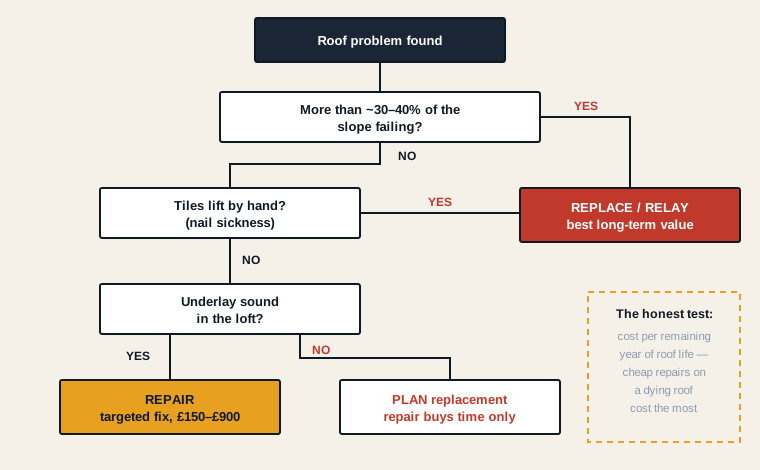
It’s the question every Cheltenham homeowner eventually faces. Your roof is leaking, or the tiles are moving, or you’ve had the same roofer out three times in two years. At what point does repair stop making financial sense?The answer depends on your property type, the roof’s age, and which materials it’s built from.
It’s the question every Cheltenham homeowner eventually faces. Your roof is leaking, or the tiles are moving, or you’ve had the same roofer out three times in two years. At what point does repair stop making financial sense?
The answer depends on your property type, the roof’s age, and which materials it’s built from. Here’s how we assess it.
When Repair Is the Right Call
Repair is the right choice when the underlying structure and covering are fundamentally sound. Signs that repair will hold:
- The roof is under 20 years old (concrete tile) or under 40 years old (Welsh slate)
- Damage is isolated — a specific area of slipped slates or one failed flashing
- The rest of the roof surface is in good condition when inspected from ridge to eaves
- No widespread nail corrosion or widespread mortar failure on ridges and hips
- No signs of felt deterioration or structural movement in the rafters
On Cheltenham’s Victorian and Edwardian terraces in St Paul’s, Fairview and Lansdown — where original Welsh slate can be 100–150 years old — individual slate repairs are often the most sensible approach. Welsh slate has a natural lifespan of 80–150 years; the fixings fail before the slate does. Replacing fixings and a handful of slates on a structurally sound Victorian terrace can extend the roof’s life by another decade or more.
NFRC guidance recommends that all roofing contractors carry a minimum of £2 million public liability insurance and that homeowners verify trade body membership before engaging any contractor.
When Replacement Is Better Value
There are five situations where repair stops making financial sense:
1. Nail sickness on post-war concrete tiles
The 1960s–70s estates across Hester’s Way, Benhall and Up Hatherley were largely built with concrete interlocking tiles fixed with galvanised nails. After 40–50 years, those nails corrode and the tiles begin to move. Individual re-nailing may help in the short term, but if nail sickness is widespread across the roof, tiles will continue to lift in every storm. At this point, a full strip and relay is more cost-effective than repeated repair call-outs.
2. More than 25–30% of tiles damaged or loose
Once a significant proportion of the covering is compromised, the cost of sorting individual areas approaches or exceeds the cost of a full replacement. We call this the 30% threshold.
3. Multiple failed flashings
If lead flashings are failing around chimney stacks, bay windows, dormers and valleys simultaneously, it usually indicates the felt underlay has also deteriorated. At that stage, stripping and relaying is cleaner than addressing each flashing failure in sequence.
4. Persistent leaks despite completed repairs
If you’ve had the same area repaired more than twice and the leak recurs, the problem is almost certainly in the underlying felt or battens — neither of which can be fixed without lifting the tile covering.
5. Structural movement
A sagging ridge, bowing roof plane or visible deflection in the rafters means the structure below the covering needs attention. This work requires a full strip regardless, so it makes sense to replace the covering at the same time.
Not sure whether your Cheltenham roof needs repair or replacement? We’ll inspect it and give you a written assessment with no obligation to proceed.
📞 Book a Free Survey — 0124 235 2251The 50% Rule
A useful rule of thumb: if the cost of the repair you need exceeds 50% of the cost of a full replacement, it’s generally worth replacing. At that level you’re committing significant money to a roof that will likely need further attention rather than starting fresh with new materials and a 10-year guarantee.
Material Lifespan Reference
| Material | Typical Lifespan | Common Cheltenham Examples |
|---|---|---|
| Welsh slate (original) | 80–150 years | Victorian/Regency properties, Montpellier, St Paul’s |
| Plain clay tile | 60–100 years | Edwardian terraces, early 1900s stock |
| Concrete interlocking tile | 30–50 years | Post-war estates, Hester’s Way, Benhall |
| Modern clay plain tile | 60–80 years | 1990s+ new builds |
| GRP flat roofing | 25–40 years | Rear extensions, garages across all eras |
Last reviewed: August 2026 by Cheltenham Roofing Experts.