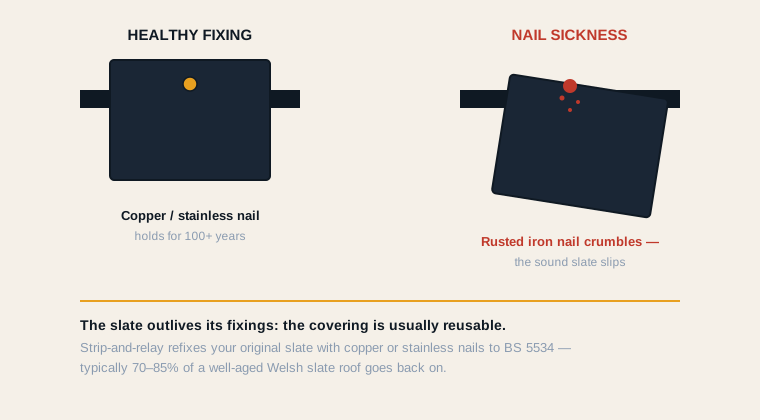
Nail sickness is one of the most common roofing problems in Cheltenham and one of the least understood. It affects the large post-war concrete tile estates that cover much of the town's residential fringe, and it has reached the point where many of these roofs are now at or past the point where repair is a viable long-term solution.
Nail sickness is one of the most common roofing problems in Cheltenham and one of the least understood. It affects the large post-war concrete tile estates that cover much of the town's residential fringe, and it has reached the point where many of these roofs are now at or past the point where repair is a viable long-term solution. This guide explains what it is, which properties are most affected, and what to do about it.
What is Nail Sickness?
Nail sickness is the corrosion of the galvanised steel fixing nails used to attach concrete interlocking tiles to roofing battens. From the 1950s through the 1980s, most UK concrete tile roofs were fixed with galvanised nails. These nails had a zinc coating that has now been consumed by corrosion — typically after 30–40 years. Once the zinc is gone, the nail corrodes rapidly and loses its structural integrity.
The effect is straightforward: tiles that were firmly fixed begin to lift at the tail, slide down or, in stronger winds, become displaced entirely. The tiles themselves are often in good condition — it is purely the fixing that has failed.
NFRC guidance recommends that all roofing contractors carry a minimum of £2 million public liability insurance and that homeowners verify trade body membership before engaging any contractor.
Which Cheltenham Properties Are Most Affected?
The most affected properties are those built between approximately 1955 and 1985 using concrete interlocking tiles. In Cheltenham, this covers:
- Hester's Way — large post-war estate, predominantly 1960s–70s housing with widespread nail sickness
- Benhall — similar vintage and profile to Hester's Way
- Up Hatherley — substantial 1970s–80s residential development
- Churchdown and Brockworth — post-war estate housing on Cheltenham's eastern fringe
- Bishops Cleeve — large residential expansion from the 1960s–80s
Properties on exposed north and west-facing slopes in these areas are typically most severely affected, as the combination of higher wind exposure and wetter conditions accelerates both nail corrosion and tile movement.
Signs of Nail Sickness on a Cheltenham Roof
From ground level, look for:
- Tiles that are not parallel with their neighbours — one corner slightly lower than the next tile
- Gaps appearing between tile tails that were previously flush
- Tiles that have slipped down to reveal the tile above
- In more advanced cases, tiles displaced entirely leaving dark gaps in the roof slope
- Ridge tiles that are loose or have shifted position
From inside the loft, advanced nail sickness is sometimes detectable as daylight visible through the roof covering, or as movement in tiles when tested from below — though this requires safe loft access.
Concerned about nail sickness on your Cheltenham property? Free survey with written condition report and honest advice on repair vs replacement.
📞 Call 0124 235 2251 — Free SurveyRepair vs Replacement — The Honest Answer
Where nail sickness affects only a small proportion of tiles — say, fewer than 15–20% — re-nailing the affected tiles with stainless steel storm clips is a reasonable intermediate measure. Where nail sickness is widespread across a whole slope, re-nailing is not economic — the number of tiles to be individually accessed makes the labour cost approach or exceed that of a full strip and relay.
Our assessment at survey stage will tell you which applies to your property. We do not recommend replacement to generate a larger job — if isolated repair is genuinely the right answer, we will say so. But on many Cheltenham post-war roofs that are now 40–50 years old with widespread nail sickness, replacement using a modern concrete tile with correct stainless steel fixings is the only economically sound solution.
What Does Nail Sickness Repair or Replacement Cost in Cheltenham?
Isolated re-nailing with stainless steel storm clips costs £15–25 per tile accessed, including scaffold and materials. For a typical Cheltenham semi where 30–40% of one slope is affected, this typically costs £600–1,400. For widespread nail sickness across the whole roof, a full re-roof in modern concrete tile typically costs £4,500–7,500 for a 3-bed semi including scaffold, felt, battens and tiles.
Last reviewed: August 2026 by Cheltenham Roofing Experts.