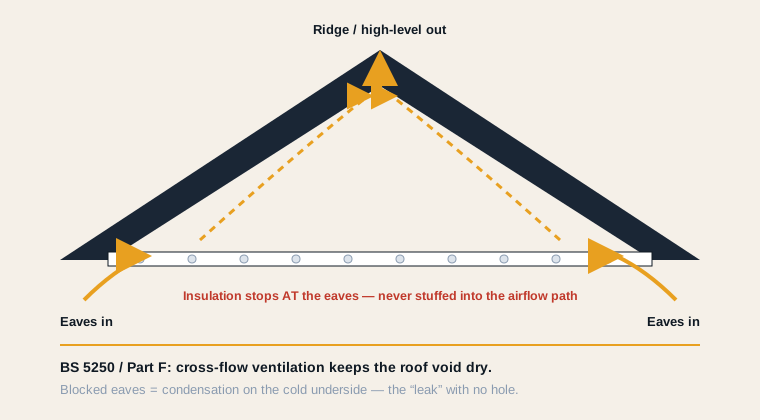
Moisture in a Cheltenham loft space or on a ceiling below the roof can have two very different causes: condensation or a roof leak. They require completely different responses, and treating one as the other wastes money and leaves the problem unresolved.
Moisture in a Cheltenham loft space or on a ceiling below the roof can have two very different causes: condensation or a roof leak. They require completely different responses, and treating one as the other wastes money and leaves the problem unresolved. Cheltenham's higher than average ambient humidity — a consequence of its Cotswold escarpment position — makes condensation more common here than in drier inland towns, which means the distinction matters more.
The Fundamental Difference
A roof leak brings external water into the building through a failure in the roof covering or flashings. It is driven by rainfall. Condensation forms within the building when warm, moisture-laden air meets a cold surface and deposits its water vapour. It is driven by temperature differentials and moisture production inside the building.
The practical difference is that a roof leak is worse during and after rain, while condensation is worse during cold weather — particularly on cold, clear nights when surfaces cool rapidly. A loft that shows moisture only in cold weather with no correlation to recent rainfall is almost certainly a condensation problem, not a roof leak.
NFRC guidance recommends that all roofing contractors carry a minimum of £2 million public liability insurance and that homeowners verify trade body membership before engaging any contractor.
Symptoms of Condensation in Cheltenham Loft Spaces
Condensation in a loft space presents differently from a roof leak and is diagnosable with care:
- Generalised surface moisture on cold surfaces — rafters, felt, the underside of slates — rather than localised dripping or running water
- White bloom or salt deposits on timber surfaces — the mineral residue left as evaporating condensation water dries
- Mould growth on north-facing felt surfaces and on shaded rafter sections, typically starting as small black spots
- Timing correlation with cold weather rather than rainfall — worse after a cold night, not after rain
- Uniformly damp feel across multiple roof surfaces rather than a specific wet patch tracking back to a single failure point
In Cheltenham's damp climate, an uninsulated and unventilated cold loft will show condensation on cold surfaces. This is not a roof failure — it is a building physics issue that requires insulation and ventilation improvement rather than roof repair.
Symptoms of a Roof Leak in Cheltenham
- Localised dripping or running water in the loft during or after rain
- Staining or water marking that tracks along a rafter or batten to a specific high point
- Daylight visible through the roof covering in dry conditions when in the loft with lights off
- Correlation with specific weather events — leaks appear or worsen during and after heavy rain, not during cold spells
- Wet insulation directly below a specific roof area rather than general surface dampness
Not sure whether it is condensation or a roof leak in your Cheltenham property? Free survey with written diagnosis. No obligation.
📞 Call 0124 235 2251Why Cheltenham Properties are More Susceptible to Loft Condensation
Cheltenham's position at the foot of the Cotswold escarpment creates an ambient humidity level that is measurably higher than the surrounding Midlands lowlands. South-westerly air masses lose moisture as they lift over the escarpment, but the town itself sits in a valley where moisture accumulates. This higher baseline humidity means that Cheltenham loft spaces — particularly uninsulated ones with limited ventilation — experience more condensation events per year than equivalent properties in drier inland locations.
The post-war housing stock on Cheltenham's estates, where loft insulation has often been improved at floor level without attention to ventilation, frequently has the conditions that promote condensation: a warm, moist air source below (the insulated floor), a cold surface above (the uninsulated felt and slate), and restricted cross-ventilation from blocked eaves. In these lofts, we regularly find felt staining, surface mould and early timber rot that is entirely attributable to condensation rather than any roof failure.
The Simple Diagnosis Test
Keep a diary for four weeks, noting:
- Whether loft moisture is worse after rain or after cold nights
- Whether the moisture is in one specific location or spread across the loft
- Whether you can trace any running water to a specific high point on the roof
- Whether there is daylight visible through the roof covering (check on a bright day with loft lights off)
If the moisture correlates with cold weather and is spread generally across the loft, it is condensation. If it correlates with rain and tracks to a specific point, it is a roof leak. If you are still unsure after four weeks of observation, call us for a free survey — we will diagnose the root cause definitively and advise on the appropriate response.
What to Do About Each
Condensation: Improve loft floor insulation to reduce warm air loss into the loft space. Improve eaves ventilation (minimum equivalent of a 25mm continuous gap) and add ridge ventilation if absent. Consider a vapour control layer on the loft floor insulation to reduce moisture transfer. In severe cases, a whole-house positive input ventilation unit controls moisture production at source.
Roof leak: Identify the source with professional loft access — trace water from the visible entry point on the ceiling back to the highest wet point in the loft. Common sources in Cheltenham are chimney flashing failure, valley blockage causing water to back up under tiles, nail-sick tiles allowing wind-driven rain under the laps, and ridge mortar failure. We identify and repair the source in a single visit where materials allow.
Last reviewed: August 2026 by Cheltenham Roofing Experts.